You’ve poured your savings into product development. You’ve successfully navigated the manufacturing maze. Now, you’re staring at two massive platforms, trying to decipher which one won’t eat your entire margin before you even see a profit.
If you are feeling nervous about platform fees, you are right to be cautious. In the world of e-commerce, fees are the silent killer of private label brands.
When sellers compare TikTok Shop and Amazon FBA, the conversation usually starts and ends with the headline numbers. Amazon is often viewed as the expensive, predictable giant, while TikTok Shop is seen as the cheaper, albeit more volatile, newcomer. But relying on surface-level percentages is a dangerous game for an entrepreneur investing their own capital.
The truth about profitability sits somewhere in the middle. To navigate with confidence, you need to understand not just what you pay, but what you are paying for. This guide cuts through the noise to provide a transparent, side-by-side breakdown of the real costs involved in selling on these two powerhouses.
The Amazon Fee Structure: Paying for Access
Amazon is a mature marketplace. When you pay fees here, you are paying for infrastructure and access to customers who are already searching with their credit cards in hand.
The cost structure is rigid but straightforward. It is designed for sellers who want a “hands-off” logistics experience, but that convenience comes at a premium.
Referral Fees
For most categories, Amazon charges a flat 15% referral fee. Think of this as your commission to the landlord for letting you set up shop in the world’s busiest mall. This fee is calculated on the total sales price, not your profit.
Fulfillment by Amazon (FBA) Fees
If you use Amazon’s logistics network (which you effectively must to get the Prime badge and win the Buy Box), you pay fulfillment fees. These cover picking, packing, and shipping. While fees vary by size and weight, they typically consume 20–35% of revenue for standard private label products.
Advertising Costs (PPC)
Here is where margins often vanish. Amazon is a “pay-to-play” arena. Organic reach is difficult for new brands without sales history. To get visibility, you must run Sponsored Products ads. Advertising costs often consume another 10–30% of revenue.
The “All-In” Amazon Reality
When you layer these costs—referral, fulfillment, and advertising—many Amazon sellers are operating at an all-in platform cost of 45–65% before they even account for their own overhead, cost of goods sold (COGS), or branding efforts.
This high barrier to entry is why many entrepreneurs feel squeezed. You are paying for high-intent traffic, but the price of admission is steep.
The TikTok Shop Fee Structure: Paying for Attention
TikTok Shop is different. It is not just a shelf; it is a stage. The cost structure here reflects a different philosophy: you aren’t paying for demand that already exists; you are paying to create demand from scratch.
The “6%” Myth
TikTok Shop starts with a deceptively low platform fee—around 6%. Many sellers hear this number and assume it is the promised land of profitability. In reality, this is only the starting point. If you build your business model assuming a 6% cost, you will run out of cash quickly.
Payment Processing
Unlike Amazon, where processing is often wrapped into the fees, you must account for roughly 2–3% in payment processing fees on TikTok Shop.
Fulfilled by TikTok (FBT)
Just like Amazon FBA, TikTok offers its own logistics solution: Fulfilled by TikTok (FBT). The pricing is competitive, often undercutting Amazon to attract sellers.
- Per-unit fulfillment: Typically around $3.50 for single-unit orders.
- Storage: Currently, storage is often free for up to 60 days, a massive incentive for new product launches.
The Marketing Variable: Affiliates and Ads
This is the single biggest differentiator. On Amazon, you pay for clicks (PPC). On TikTok Shop, you largely pay for performance through affiliates.
- Organic Affiliate Commissions: To get creators to promote your product, you must offer a commission. This usually sits between 15–30%. If you offer less, creators will simply ignore your product in favor of competitors offering better rates.
- GMV Max & Ads: TikTok’s advertising engine (GMV Max) helps drive sales through paid placement. Ad-driven sales frequently carry lower affiliate commissions, closer to 10%, but the ad spend itself can range from 5–20% depending on your scale and creative efficiency.
Sampling Costs
This is a hidden cost that catches many private label owners off guard. To get those affiliates to post videos, you have to send them the product. Brands routinely send free product to hundreds of creators with no guarantee of posting. This directly impacts your margins and inventory levels.
The “All-In” TikTok Reality
When you combine the platform fee, processing, fulfillment, affiliate commissions, ad spend, and the cost of sampling, TikTok’s true cost usually lands anywhere between 30–55%.
While the ceiling is lower than Amazon’s 65%, the floor is higher than the advertised 6%. The sellers who succeed on TikTok Shop are not the ones chasing gross merchandise value (GMV)—they are the ones who understand contribution margin before they scale.
Comparison: Where Does Your Dollar Go?
To make an informed decision, you need to see exactly where the money goes. Here is how a hypothetical $30 product might break down on both platforms.
Scenario: Selling a $30 Wellness Supplement
Amazon FBA Breakdown:
- Referral Fee (15%): $4.50
- FBA Fee (Est.): $5.50
- Storage/Inventory Placement: $0.50
- PPC Ad Spend (20% TACOS): $6.00
- Total Platform Cost: $16.50
- Percentage of Revenue:55%
TikTok Shop Breakdown:
- Platform Fee (6%): $1.80
- Payment Processing (2.5%): $0.75
- FBT Fulfillment: $3.50
- Affiliate Commission (20% avg): $6.00
- Sampling/Content Cost (amortized): $1.50
- Total Platform Cost: $13.55
- Percentage of Revenue:45%
In this scenario, TikTok Shop leaves you with an extra 10% margin. However, this assumes you can successfully recruit affiliates to sell your product for a 20% commission. If you have to raise that commission to 30% to compete for creators, the costs become nearly identical to Amazon.
The Philosophical Difference: Demand Capture vs. Demand Creation
The numbers tell you how much you pay, but they don’t tell you why. Understanding the “why” is crucial for mitigating risk.
Amazon is for Demand Capture.
Amazon charges you for access to people who typed “magnesium supplement” into the search bar. These people are ready to buy. You pay high fees because the conversion rate is incredibly high. You are paying for certainty.
TikTok Shop is for Demand Creation.
TikTok charges you for distribution and attention. The user scrolling their “For You” feed wasn’t looking for a magnesium supplement. Your content (or your affiliate’s content) interrupted their entertainment and convinced them they needed it. You are paying for discovery.
This distinction is vital because it affects your entire business ecosystem. When TikTok works, it doesn’t just drive sales inside the app—it creates a “Halo Effect.”
The Halo Effect
Many brands are willing to break even on TikTok Shop because the downstream demand creation makes the entire ecosystem more profitable.
- A user sees your viral video on TikTok.
- They don’t buy immediately.
- Later, they go to Amazon and search for your brand name specifically.
- You capture that sale on Amazon without paying for expensive generic PPC keywords.
In this way, TikTok Shop acts as a top-of-funnel marketing machine that lowers your customer acquisition cost (CAC) across every other channel.
Hidden Risks You Must Consider
As an entrepreneur investing your own capital, you need to be aware of the risks that don’t show up on a fee schedule.
Volatility on TikTok
Amazon is steady. If you rank well, you stay there until a competitor knocks you off. TikTok is volatile. A video might go viral today and generate 1,000 orders, and then you might have zero sales for the next three days. This feast-or-famine cycle makes inventory planning incredibly difficult and stressful for risk-averse owners.
The Content Treadmill
On Amazon, you optimize your listing once, and maybe update photos every six months. on TikTok, content has a shelf life of days. To maintain sales, you need a constant stream of new videos. If you aren’t producing content, you aren’t selling. This requires either your time or money to hire creators.
Returns Management
TikTok shoppers are impulse buyers. Impulse buys lead to higher return rates than high-intent Amazon searches. You must have a robust system (and budget) for handling returns, or your profits will bleed out through reverse logistics.
Which Platform Wins?
There is no single winner, but there is a right answer for your specific situation.
Choose Amazon FBA if:
- You want stability and predictability.
- You have a product that solves a specific problem people are actively searching for.
- You prefer logistics and data over content creation and community management.
- You have the margin to absorb higher fees in exchange for lower hands-on marketing time.
Choose TikTok Shop if:
- You have a visually demonstrable product.
- You are comfortable with volatility and rapid shifts in trends.
- You want to build a brand and community, not just sell a commodity.
- You are willing to manage affiliate relationships and aggressive content strategies.
The Strategic Path Forward
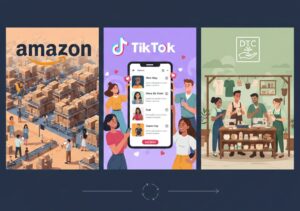
For most modern private label brands, the goal shouldn’t be “TikTok vs. Amazon.” It should be “TikTok and Amazon.”
The most successful entrepreneurs we see use TikTok Shop to drive brand awareness and initial sales velocity, while using Amazon FBA as their reliable backend for capturing the long-term demand that TikTok creates.
Don’t let the fear of fees paralyze you. Yes, the costs are high on both sides, but they are the cost of doing business in the modern economy. By understanding the true breakdown—beyond the surface-level percentages—you can price your products correctly, manage your cash flow, and ensure that every sale contributes to your bottom line.
Secure your investment returns by knowing the numbers cold. When you understand the game, you stop gambling and start executing.
Meta data
Meta title
TikTok Shop Fees vs Amazon FBA: The Real Cost Breakdown
Meta description
Don’t be fooled by the “6% fee.” We break down the true costs of TikTok Shop vs Amazon FBA to help you decide where to invest your capital safely.