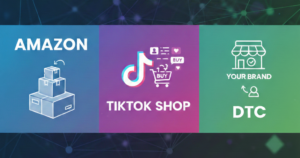
Every seller asks the same question eventually: Amazon vs TikTok Shop, and which one should get your budget first? The honest answer is that they solve different problems, and for most brands the real winning move isn’t picking one. It’s sequencing both correctly.
At Bullseye Sellers, we’ve managed ecommerce growth across Amazon, TikTok Shop, and Shopify since 2018. We currently manage 121 TikTok Shops and 85 Amazon accounts, spanning every revenue tier from pre-revenue to $100K+ a month, and we run Amazon accounts for private label and DTC brands at the same time. That dual vantage point is why we can say with confidence: this isn’t an either/or decision. It’s a sequencing decision, and getting the order wrong is the most expensive mistake a seller makes.
This guide breaks down how Amazon and TikTok Shop actually compare on fees, launch budget, growth curve, and audience, then walks through how to decide which platform to launch first.
How does TikTok Shop differ from Amazon?
TikTok Shop is TikTok’s built-in ecommerce marketplace, letting brands sell directly inside the TikTok app through short-form video, livestream shopping, and a dedicated Shop tab.
Amazon is a search-driven marketplace where shoppers arrive already looking for a product. Demand is captured, not created. The algorithm rewards search relevance, conversion rate, and reviews.
TikTok Shop is a discovery-driven marketplace where creators introduce a product to shoppers who weren’t searching for it at all. The algorithm rewards creator attention, watch-through rate, and GMV velocity.
That distinction is the whole ballgame. U.S. small businesses selling on TikTok Shop grew sales by 66% year-over-year in 2025, and more than 215,000 small businesses were actively selling on the platform in the U.S. by the end of that year, up 25% year-over-year. Growth on TikTok Shop is real and it’s accelerating, but it runs on a different engine than Amazon does.
Amazon vs TikTok Shop fees: how do the costs compare?
Amazon referral fees range from 8% to 15% of the sale price depending on category, with most categories charged 15% in 2026. On top of that, FBA fulfillment runs roughly $3 to $6 per unit for standard-size products, plus storage fees, so your effective margin shrinks fast once inventory and fulfillment costs are layered on top of the referral fee.
TikTok Shop works differently. Instead of one flat referral fee, sellers pay a platform fee of roughly 2% to 8% depending on category, plus a commission to the creators and affiliates who drove the sale.
| Platform | Core cost structure | 2026 rate range |
| Amazon | Referral fee by category, plus FBA fulfillment and storage | 8-15% referral + ~$3-$6/unit fulfillment |
| TikTok Shop | Platform fee, plus creator/affiliate commission that varies by growth stage | 2-8% platform fee + 13.6-17.1% average creator commission |
Across the 121 shops we manage, commission rates paid to creators run between 13.6% and 17.1% depending on growth stage, and the biggest shops actually pay less in commission (14.9%) than mid-stage shops (17.1%). Early on, a higher commission is what gets creators to take a chance on an unproven product. Once a shop has sales history and social proof, commission rate stops being the lever that moves growth.
The practical takeaway on Amazon vs TikTok Shop fees: Amazon’s cost structure is predictable and product-category-driven. TikTok Shop’s cost structure is tied to your growth stage and how much of your GMV comes from creators versus ads versus product-card browsing.
What’s the realistic launch budget for each platform?
Budget is where most first-time sellers get caught off guard, on both platforms.
- Amazon: Beyond referral and fulfillment fees, expect to spend $2,000 to $5,000 or more on PPC in your first 60 days just to build enough sales velocity to rank, with CPC running $1.50 to $4.00+ on competitive keywords. You’ll also need 15 to 25 reviews before conversion rates normalize, which takes 30 to 60 days minimum with compliant strategies. Between inventory, ads, photography, and launch costs, a realistic minimum budget to launch on Amazon properly is $10,000 to $20,000.
- TikTok Shop: Your product needs to be visually demonstrable on video, priced in the $20 to $80 sweet spot for impulse buys, and have a use case a creator can show in 30 to 60 seconds. Add an inventory buffer to cover the cold-start period, sample product for creators, and potentially a management fee, and a realistic minimum to get through cold start and build traction is $5,000 to $12,000.
Should you launch on Amazon or TikTok Shop first?
If budget only allows for one platform at a time, launching on Amazon first and adding TikTok Shop six months or more later is usually the safer sequence for most brands. But the right launch order depends on your product, not on which platform sounds trendier.
Launch on Amazon first if:
- Your product solves a specific, searchable problem with a clear keyword (supplements, tools, pet products, home goods)
- You have $15,000+ to invest in a proper launch
- You want predictable, recurring revenue with less volatility
Launch on TikTok Shop first if:
- Your product is visually compelling and demonstrable in a short video
- Your price point is in the $20 to $80 range
- You have limited capital and need a lower minimum buy-in
- You’re willing to commit to 60+ days to break through cold start
Launch on both simultaneously if:
- You have the capital to fund both platforms properly
- You have the operational bandwidth to manage both channels, or an agency doing it for you
- You want the Amazon spillover effect, where TikTok brand awareness drives branded searches on Amazon
This is where a specialized TikTok Shop management partner earns its keep. We’ve seen Amazon brands add $50,000 to $150,000 a month in GMV by layering TikTok Shop on top of an established Amazon presence.
Bullseye Sellers benchmark study
Our census of 121 managed shops found virtually no instances where a shop grew to make over $10,000 per month relying solely on organic growth.
Above that threshold, paid TikTok ads were universal across every shop we manage. Sellers who try to grow on creator content alone, without pairing it with ads, are fighting the algorithm with one hand tied behind their back, and most don’t realize it until months of stalled growth have already gone by.
Bullseye Sellers has taken shops from zero revenue to real GMV milestones using this exact sequencing logic. One toy brand reached over $1,000,000 per month in GMV in under four months with zero initial ad spend, purely through structured affiliate recruitment, and saw a 10x lift in Amazon branded search as a result.
A greeting card brand scaled to over $960,000 per month in six months while generating 30 million-plus organic views. If you’re weighing Amazon vs TikTok Shop and aren’t sure where to start, talk to our team about a launch roadmap built around your specific product.
Is TikTok Shop worth it for small or handmade brands?
Yes, and you don’t need an existing following to make it work. TikTok Shop’s algorithm surfaces content based on interest signals, not follower counts, so a brand with zero followers can still land in front of an engaged, relevant audience through creator partnerships. Handmade, beauty, and specialty goods brands tend to perform especially well because the format rewards visual storytelling over polished catalog photography, and because these products fit naturally into the $20 to $80 impulse-buy price range that converts best on the platform.
The tradeoff is patience during the early stage. Our data shows shops under $10,000 a month rely on product-card browsing for 26% of GMV, versus just 13 to 14% at higher tiers, meaning early-stage shops are still surviving on passive traffic rather than creator-driven demand. That gap closes once video volume and sales history build up.
Is it worth selling on both Amazon and TikTok Shop?
For most established sellers, yes. The two platforms feed each other rather than compete for the same dollar.
- Fresh Monster hit a $103,000-per-month run rate on TikTok Shop within nine months while its branded search on Amazon lifted 3x in the same period.
- Almond Clear saw Amazon search interest jump more than 100% after building out its TikTok Shop presence from scratch.
This spillover effect shows up in client feedback too. As one Bullseye Sellers client said:
“Since starting TikTok with Eric’s team we have seen a huge jump in organic traffic to Amazon… Some of our TACOS are down to 3% from 7%.”
Running both channels isn’t double the work for double the risk. Done right, it’s one growth engine feeding the other.
The one caveat worth flagging: if your affiliate share of TikTok Shop GMV climbs above roughly 85%, that’s a concentration risk, not a growth engine, and it’s worth diversifying into product-card and owned demand alongside creator content.
How do you measure whether Amazon or TikTok Shop is working better for you?
Track GMV, ad-attributed revenue, cost per order, and refund rate separately for each platform, and watch how they trend relative to each other. On TikTok Shop, cost per order is the earliest warning sign: across our managed shops, it drops from $24.62 at launch to $7.15 once a shop hits $50K–$100K in monthly revenue. If yours isn’t trending down as volume grows, that’s a creative or targeting problem, not a bidding one.
Conversion rate is the metric to stop chasing. Across all 121 shops we manage, it holds steady at 3.4%–3.9% regardless of revenue tier. Bigger shops don’t convert better, they just feed more qualified traffic into the same funnel.
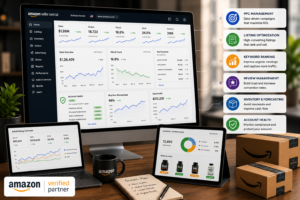
This is exactly the kind of cross-platform signal most sellers can’t see in real time, and it’s where HyperPilot AI comes in. Our Amazon management platform pulls GMV, cost per order, and refund data into one view so you can catch a stalling cost-per-order trend before it eats your margin, instead of finding out a month later in a spreadsheet.
Why sellers choose Bullseye Sellers for Amazon and TikTok Shop growth
Bullseye Sellers has managed ecommerce growth across Amazon, TikTok Shop, and Shopify since 2018, giving us a rare cross-platform view most single-channel agencies don’t have. We currently manage 121 active TikTok Shops, with $36M in projected GMV under management and over 100,000 affiliate creators engaged across our client base.
Our TikTok Shop account managers, including lead account manager Eric Young, work directly with brands from onboarding through scaling, overseeing affiliate outreach, creator partnerships, and GMV Max ad campaigns.
“Bullseye Sellers helped us to grow our TikTok Shop sales from an average of $4k monthly to over $100k monthly. They manage our entire TikTok Shop and affiliate program, which allows my team to focus on other initiatives.” – Real client review
What services are included in TikTok Shop and Amazon management?
Bullseye Sellers offers full-service management across both platforms, including:
FAQs: Amazon vs TikTok Shop
How long does it take to see results on TikTok Shop? Based on Bullseye Sellers’ managed shop data, the average shop takes about four months to escape the early cold-start phase and reach consistent monthly growth. Results vary by category and creative supply, but shops that pair creator seeding with paid ads from the start tend to move through this phase faster than those relying on organic content alone.
What’s the minimum budget to launch on Amazon vs TikTok Shop? A realistic minimum is $10,000 to $20,000 for a proper Amazon launch, and $5,000 to $12,000 to get a TikTok Shop through cold start. Amazon’s spend goes mostly to inventory, PPC, and reviews. TikTok Shop’s spend goes mostly to inventory buffer, creator sampling, and management.
Do I need a large following to sell on TikTok Shop? No. TikTok Shop’s algorithm ranks content by audience interest rather than follower count, so brands with zero existing followers regularly achieve strong results by placing products with creators who already have engaged audiences.
Can I sell the same products on Amazon and TikTok Shop at the same time? Yes, and many sellers do. Running both channels concurrently is common, especially once a brand has enough inventory and fulfillment capacity to support demand from two channels at once. TikTok Shop activity frequently drives a measurable lift in Amazon branded search as a side effect.
Does TikTok Shop sales activity affect my Amazon rankings? Indirectly, it can. Several Bullseye Sellers clients have seen branded search volume and organic traffic on Amazon increase after ramping up TikTok Shop activity, since creator content builds outside awareness that shoppers later act on by searching the brand name directly on Amazon.
Which platform has lower fees, Amazon or TikTok Shop? Amazon’s referral fee is a flat 8% to 15% of the sale price by category, plus FBA fulfillment costs of roughly $3 to $6 per unit. TikTok Shop’s effective cost combines a 2% to 8% platform fee with a 13.6% to 17.1% creator commission, plus any ad spend. Neither platform is categorically cheaper; the right comparison depends on your category and how much of your TikTok Shop GMV comes from ads versus organic creator content.
Should I run ads on TikTok Shop or rely on organic creator content? Both, ideally. Across managed shops, paid ads were in universal use above the $10,000-a-month mark, and no meaningful population of shops scaled past that threshold on organic content alone. Ads generate the conversion signal the algorithm needs to show your product to people who weren’t already searching for it.
Ready to decide where to sell next? Talk to Bullseye Sellers about a launch roadmap for Amazon, TikTok Shop, or both.