Launching a new private label brand is one of the most terrifying and exhilarating things you can do. You’ve poured your savings into inventory, spent sleepless nights stressing over packaging, and now you’re staring at the biggest question of them all: Where do I actually sell this thing?
The “gurus” will tell you to be everywhere at once. They’ll say you need a Shopify store for the margins, an Amazon listing for the traffic, and a viral TikTok account for the hype.
Here is the honest truth: If you try to do all three at launch with limited capital and a small team (or just you), you will burn out, and you will burn through your cash.
To survive the first year, you need focus. You need a platform that validates your product quickly, generates cash flow, and builds the one asset that matters more than anything else: trust.
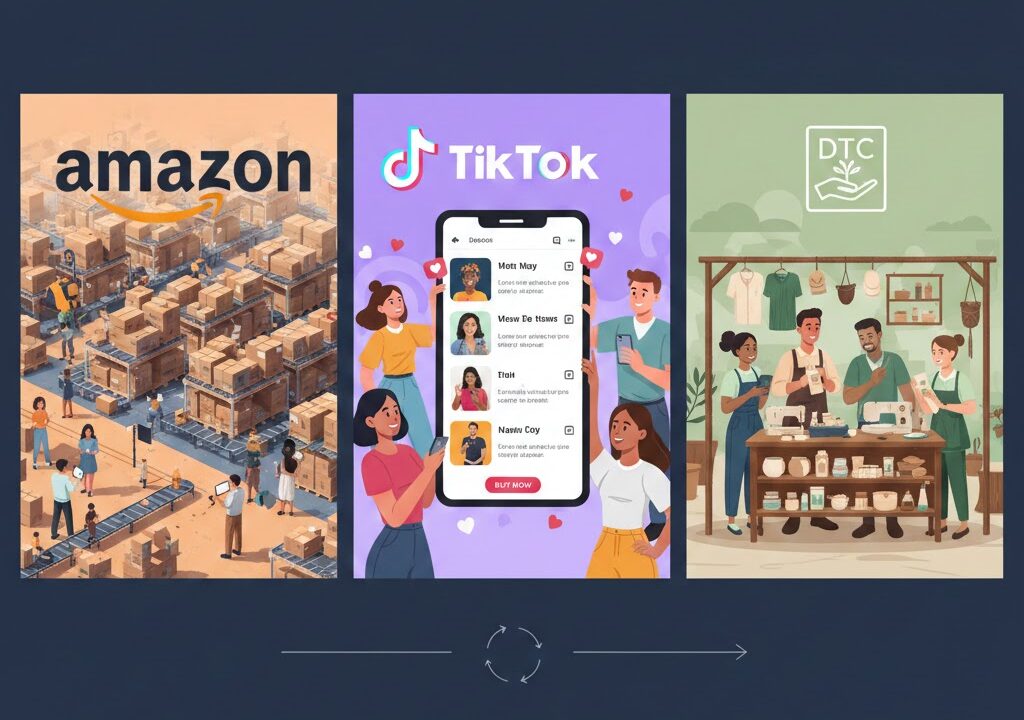
We are going to do a deep dive into the three main launch vehicles—Amazon, TikTok Shop, and Direct-to-Consumer (DTC). We’ll break down the pros, the cons, the capital requirements, and the hard realities of each. By the end, you will have a clear, data-backed roadmap on where to place your bet.
Option 1: The DTC Dream (Shopify)
Let’s start with the one everyone wants to do. The Direct-to-Consumer model is the holy grail of branding. You own the customer data, you control the pixel, and nobody takes a referral fee off the top. It sounds perfect.
But in 2024, the DTC landscape is a minefield for new brands without deep pockets.
The Reality of Customer Acquisition Costs (CAC)
Years ago, you could spin up a Facebook ad for pennies and drive traffic to a Shopify store. Those days are gone. Privacy changes (like iOS 14.5 and beyond) have made ad tracking significantly harder and more expensive.
Data from L.E.K. Consulting confirms that DTC brands are facing spiraling customer acquisition costs. You aren’t just paying for the click anymore; you are paying a premium to find the right person because the algorithms are working with less data.
When you launch DTC, you are launching on an island. No one knows you exist. You have to pay for every single pair of eyes that lands on your product page. If your conversion rate is low (which it usually is for a brand new store with no social proof), you are effectively lighting money on fire.
The Trust Barrier
Imagine you see an ad for a new supplement or a specialized kitchen gadget from a website you’ve never heard of. Do you buy it immediately? Probably not. You wonder if it’s a scam. You wonder if shipping will take six weeks. You wonder if the return policy is real.
Building a high-converting DTC site requires massive social proof—reviews, user-generated content (UGC), and press—which you simply don’t have on Day 1.
The Verdict on DTC
Pros:
- You own the customer email and phone number (crucial for long-term value).
- Higher gross margins (no 15% referral fee to a marketplace).
- Complete control over brand aesthetics.
Cons:
- Extremely high upfront marketing costs.
- Zero organic traffic (you have to buy every visitor).
- Logistics are entirely on you (shipping, returns, customer service).
Strategic Takeaway: DTC is the goal, not the starting line. Launching here first requires a massive marketing budget to overcome the “who are you?” problem.
Option 2: The Viral Wildcard (TikTok Shop)
TikTok Shop is the shiny new object in e-commerce. It is explosive, it is exciting, and the numbers are undeniable. With U.S. social commerce sales projected to reach over $71 billion in 2024, fueled largely by TikTok, the potential for a “viral moment” is enticing.
The “Virality” Trap
The allure of TikTok Shop is the idea that one video can sell out your inventory overnight. And yes, it happens. But building a business model on “hoping to go viral” is not a strategy; it’s gambling.
TikTok is an incredible demand generator. It interrupts people scrolling through entertainment and convinces them to buy things they didn’t know they needed. However, the operational backend can be chaotic. You are dealing with creators, shipping deadlines that can get your shop banned if missed, and an algorithm that can give you 100,000 views one day and zero the next.
The Creator Commission Reality
While TikTok Shop fees are generally lower than Amazon’s, you have to factor in affiliate commissions. To get traction, you often need to pay creators 10% to 20% (or more) of the sale price to promote your product. When you combine the platform transaction fees with shipping costs and creator commissions, your margins can get squeezed just as tight as on Amazon.
The Verdict on TikTok Shop
Pros:
- Massive potential for explosive brand awareness.
- Subsidized shipping and coupons (TikTok is currently burning cash to acquire users, which benefits sellers).
- Video-first format explains complex products well.
Cons:
- Inconsistent sales (feast or famine).
- High workload (you need to produce content constantly or manage hundreds of creators).
- Customer intent is “impulse,” which leads to higher return rates.
Strategic Takeaway: TikTok Shop is an accelerant. It’s gasoline. But you need a fire first.
Option 3: The Trust Engine (Amazon)
Now, let’s talk about the 800-pound gorilla. Amazon captures roughly 37.6% of all U.S. e-commerce spending. That is a staggering statistic. But here is the more important one: 90% of consumers check Amazon prices or reviews even if they find a product elsewhere.
The Power of “High Intent”
Unlike TikTok (where people are looking to be entertained) or Facebook (where people are looking at photos of their friends), people go to Amazon with one specific intent: to buy stuff.
When you launch on Amazon, you are tapping into a river of customers who already have their credit cards linked and Prime memberships active. You don’t have to convince them to trust the shipping speed; they trust Amazon. You don’t have to convince them the return policy is safe; they trust Amazon.
You are “renting” Amazon’s credibility. For a new private label brand with zero reputation, that credibility is the most valuable asset you can buy.
The Economics of FBA
Yes, the fees hurt. Between the Referral Fee (usually 15%) and the FBA (Fulfillment by Amazon) fees, Amazon is going to take 30% to 40% of your revenue.
However, consider what that fee replaces:
- Warehousing: You don’t need a storage unit.
- Pick and Pack: You don’t need to tape boxes.
- Shipping: You don’t need to negotiate rates with UPS.
- Customer Service: Amazon handles the “where is my stuff?” emails.
- Traffic: You can run PPC (Pay-Per-Click) ads to people searching for exactly what you sell.
The Social Proof Mechanism
This is the critical piece. Amazon Reviews are the currency of the internet. A PowerReviews survey found that 98% of consumers consider reviews an essential resource when making purchase decisions.
If you launch on Amazon and use their “Vine” program to get your first 30 reviews, you suddenly have a verified product. Those reviews act as a permanent asset for your brand. Later, when you do launch your Shopify site or run TikTok ads, potential customers will Google your brand, see your 4.5-star rating on Amazon, and feel safe buying from you.
The Verdict on Amazon
Pros:
- Immediate access to high-intent buyers.
- Logistics are handled for you (FBA).
- Builds the most trusted form of social proof (reviews).
- Consistent, predictable sales velocity compared to viral platforms.
Cons:
- High fees.
- You don’t own the customer data.
- Competition is fierce.
Strategic Takeaway: Amazon is the validation engine. It proves people want your product and are willing to pay for it.
The Winning Strategy: The “Amazon First” Approach
We know you want to own your brand. We know you want those high DTC margins. But to get there safely, you need to follow a sequence that respects your capital constraints.
Here is the step-by-step roadmap to $50k/month and beyond:
Phase 1: Validation & Cash Flow (Months 1–6)
Focus: Amazon FBA
Put 100% of your energy into Amazon. Do not distract yourself with a fancy website or a complex influencer campaign yet.
- Launch on Amazon: Optimize your listing with professional images and SEO keywords.
- Get Social Proof: Enroll in the Amazon Vine program immediately to get your first 30 reviews. This is non-negotiable.
- Run PPC Ads: Spend your marketing budget on Amazon PPC. You are targeting people who are searching for “organic face serum” or “weighted blanket.” These are the easiest sales to get.
- Goal: Get to consistent daily sales. Prove that the product works and that people like it.
Why this works: You are generating cash flow without hiring a fulfillment team or a customer service rep. You are building a reputation on the world’s most trusted marketplace.
Phase 2: Brand Awareness & Expansion (Months 7–12)
Focus: TikTok Shop
Once you have a steady stream of sales on Amazon (let’s say $20k–$30k/month) and a solid 4.5-star rating, it’s time to pour gasoline on the fire.
- Open TikTok Shop: List your products here.
- Send Inventory to Creators: Don’t just run ads. Send your product to 50–100 micro-influencers. Tell them they can earn a commission if they sell it.
- The “Halo Effect”: When a video goes viral on TikTok, many people won’t buy it on TikTok. They will close the app, open Amazon, and search for your brand. Because you did Phase 1 correctly, they will find your listing, see the reviews, and buy it via Prime.
Why this works: You are using TikTok to create cheap awareness, but you are capturing the demand on Amazon, where the conversion rate is higher.
Phase 3: Asset Ownership (Year 2+)
Focus: Direct-to-Consumer (Shopify)
Now that you have cash flow from Amazon and brand buzz from TikTok, you are ready for DTC.
- Launch Shopify: Now you can build the beautiful site.
- Capture Data: Use inserts in your packaging (if compliant) or social media contests to get customers to your site.
- Retargeting: Use the audiences you’ve built to drive traffic to your own store for repeat purchases.
Why this works: You aren’t launching to crickets. You are launching to an audience that already knows you exists.
Conclusion: Start Where the Trust Is
Entrepreneurship is about managing risk. Launching a DTC site with no reputation is high risk. Launching on TikTok with no operational backbone is high risk.
Launching on Amazon is a calculated risk. It allows you to leverage the infrastructure and trust of a trillion-dollar company to build your own.
Your Action Plan:
- Focus your capital on Amazon inventory and PPC.
- Aggressively pursue your first 30 reviews.
- Ignore the noise of other platforms until you hit $50,000 per month in revenue.
Once you hit that milestone, you have a real business. Then—and only then—do you go ham on TikTok Shop to scale it to the moon.
Meta data
Meta title
Amazon vs. TikTok Shop vs. DTC: Where to Launch Your Brand First
Meta description
Should you launch on Amazon, TikTok Shop, or Shopify? We break down the costs, risks, and strategies to help you reach $50k/month safely.