The fastest way to increase sales on TikTok Shop is to combine three levers at once: affiliate creator content, paid ads, and a listing that’s actually ready for traffic. Brands that treat these as one system, not three separate projects, grow faster than brands that pick just one and hope it carries the whole shop. This guide breaks down exactly how to increase sales on TikTok Shop if you already have a live shop and want more from it, not how to launch one from scratch.
What actually drives sales growth on TikTok Shop?
Sales growth on TikTok Shop comes from three levers working together: the affiliate creator program, paid advertising (GMV Max), and consistent native-feeling content. No single lever reliably scales a shop on its own.
The affiliate program is TikTok Shop’s built-in system for recruiting creators to post content that links directly to your product, earning them a commission on every sale. Paid ads amplify content that’s already proven itself organically, pushing it to a colder, wider audience. Content is the raw material both systems run on. Skip any one of the three and the other two run out of fuel fast.
Fix your product and listing foundation first
Before you spend another dollar recruiting creators or boosting a video, your product listing needs to be ready to convert the traffic it’s about to receive. A listing is “ready” when the title and thumbnail match what shoppers actually search for, pricing supports a healthy margin after TikTok’s fees and creator commissions, and reviews or ratings are visible.
Creator or ad traffic sent to a weak listing doesn’t just underperform, it can make an already-slow shop look worse. A listing with confusing photos or an unclear price will bounce cold traffic even when the content itself is strong. At Bullseye Sellers, our team runs a listing audit before scaling any creator or ad spend, because a $10,000 ad budget can’t fix a listing problem.
Should you prioritize affiliate marketing or paid ads to increase TikTok Shop sales?
Affiliate marketing and paid ads are not competing strategies, they’re two layers of the same growth system, and treating them as an either/or choice is the single most common mistake sellers make. Affiliate creators generate organic content and reach warmer, trust-based audiences. Paid ads, run through TikTok’s GMV Max system, take that same content and put ad spend behind whatever is already converting.
| Lever | What it does | Best used for |
| Affiliate creators | Recruits creators to post native content in exchange for commission | Building a content library and reaching trust-based audiences |
| Paid ads (GMV Max) | Puts ad spend behind content that already has proven engagement | Scaling winning content to colder, wider audiences |
| Combined | Content fuels ads, ads extend content’s reach | Sustained month-over-month sales growth |
The strongest TikTok Shop growth strategy doesn’t choose between affiliates and paid ads—it builds a feedback loop between the two. Affiliates create the content and social proof that drive initial conversions, while GMV Max identifies and scales the content that proves it can sell. When those two pieces work together, sellers can turn individual winning videos into a repeatable engine for sustained growth.
What Bullseye Sellers’ Shop Data Reveals About TikTok Shop Growth
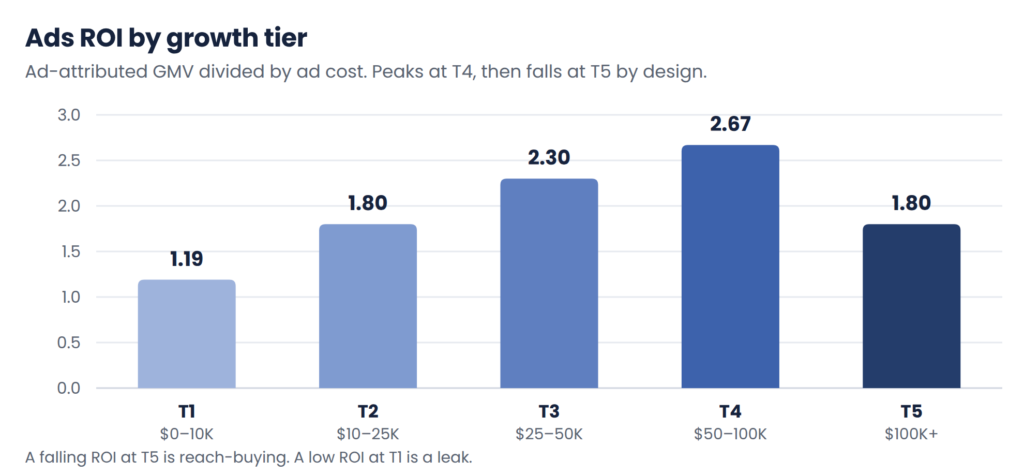

Bullseye Sellers studied performance across its managed TikTok Shop accounts to identify how sales tactics tend to differ as shops move through different levels of monthly GMV. Rather than applying the same playbook to every seller, the data points to distinct priorities at different stages of growth: building an initial content and affiliate foundation, adding paid amplification once content is proving itself, and then optimizing for efficiency and profitability as sales volume increases.
For shops generating less than $10,000 per month, the primary focus is on recruiting affiliate creators and building a library of content that can generate organic sales. At this stage, there is less proven content for paid ads to amplify. Once a shop reaches the $10,000-to-$50,000 monthly range, paid advertising becomes increasingly important for scaling content that has already demonstrated its ability to convert. For shops above $50,000 per month, the emphasis shifts toward efficiency and margin—tightening ad targeting, identifying the highest-performing creators, and optimizing commission structures around those relationships.
These observations are based on Bullseye Sellers’ managed-shop data, not a theoretical model. Across its 121-shop portfolio, every shop that crossed $10,000 in monthly sales was running paid ads, while no shop in the census scaled beyond that threshold through organic or affiliate content alone. The analysis covered a 28-day period ending in August 2026. The pattern suggests that when a seller introduces paid amplification can be just as important as whether they use it at all, with paid ads becoming a common denominator among shops that successfully moved beyond the $10,000 monthly GMV threshold.
How to increase sales from a cold start on TikTok Shop
A cold start is a shop with little to no sales history and no proven content yet, and the fix is narrower than it feels from the inside. Recruit 15 to 20 affiliate creators in your product’s niche before spending anything on ads, since ads need something to amplify. Focus creator outreach on mid-tier creators with engaged, smaller audiences rather than chasing the biggest names first, since they’re easier to recruit and often convert better per view.
Shops managed by Bullseye Sellers have escaped the cold start phase in an average of four months, based on our own portfolio data across our active growth brands. That’s the benchmark to measure your own timeline against: if a shop with a ready listing and steady creator outreach is still stuck at zero after four to six months, something upstream (usually the listing or the product-creator fit) needs attention before adding more spend.
Why are your TikTok Shop sales low even though you’re getting views?
Low sales despite decent views on TikTok Shop almost always trace back to one of four causes: a click-through rate under 1%, stale or repetitive content, a listing or compliance issue freezing conversions, or having only one of the two growth levers (affiliate or ads) actually turned on. Run through this checklist in order before assuming the product itself is the problem.
- Check your click-through rate. A CTR under 1% on your top content usually points to a thumbnail, hook, or pricing mismatch, not a traffic problem.
- Audit content freshness. Views on the same one or two videos for weeks in a row signals your content library needs new creator recruits, not more spend on what’s already fatigued.
- Verify listing and compliance health. A frozen or restricted listing can kill conversions while views keep climbing on the video itself.
- Confirm both levers are live. Views without sales frequently means only affiliate content or only ads is running, not both.
Even sellers discussing this exact problem across Reddit and LinkedIn seller communities consistently point to two root causes: weak targeting or CTR, and treating strategy as an afterthought rather than the product itself being at fault. Work through the checklist above before changing your product or pricing.
TikTok Shop features that help increase sales beyond affiliates and ads
Beyond the core affiliate-and-ads system, TikTok Shop offers several native features built specifically to convert existing traffic into sales. GMV Max is TikTok’s automated bidding and budget-allocation system that puts ad spend behind whichever content is already converting best. Video Shopping Ads let brands run standalone shoppable video ads without relying on creator content. LIVE Shopping lets brands sell directly during a livestream. Countdown bidding and shoppable photos are newer 2026 additions that give sellers more control over time-sensitive promotions and static product imagery inside the Shop feed.
Measure profit, not just GMV


Gross merchandise value tells you how much product moved, but it doesn’t tell you whether that growth was profitable, which is why tracking contribution margin alongside GMV matters more as a shop scales. A shop doing $50,000 a month in GMV with thin margins on every ad-driven sale can be in worse financial shape than a $20,000-a-month shop converting efficiently.
Ad cost per order is one of the clearest profit signals available. Across Bullseye Sellers’ 121-shop managed portfolio, ad cost per order fell from $24.62 for shops earning under $10,000 a month to $7.15 for shops in the $50,000 to $100,000 tier, a 3.4 times difference, over a 28-day window ending August 2026. Ads ROI followed the same pattern, climbing from 1.19x at the lowest tier to 2.67x at the $50,000 to $100,000 tier across that same portfolio and timeframe. Both numbers point to the same conclusion: the goal isn’t just more GMV, it’s GMV that gets cheaper to generate as the shop matures.
There are tools that can help you measure beyond GMV: Mamba pulls your orders, settlements, ad spend, and affiliate creator data directly from TikTok Shop, then reconciles it all into one number you can actually trust: what you made. Built for sellers tired of guessing—and agencies tired of reporting across twenty different accounts.
Why choose Bullseye Sellers to increase your TikTok Shop sales
At Bullseye Sellers, our team manages TikTok Shop growth for 75 active brands, has engaged more than 100,000 affiliate creators, and oversees a projected $36 million in GMV across its managed portfolio. That scale is what makes the benchmarks in this guide possible: the ad ROI, cost-per-order, and cold-start data above come from our own Growth Curve Benchmarks study across all 121 managed shops, not a single case study or an industry average.
Our client results back up the framework. One brand grew from an average of $4,000 a month to more than $100,000 a month in monthly TikTok Shop sales after we took over its entire shop and affiliate program. Another brand generated over $1,000,000 a month in GMV with zero initial ad spend, scaling purely through structured affiliate recruitment before adding paid amplification. At Bullseye Sellers, our team’s TikTok Shop management service runs this exact affiliate-plus-ads system for brands ready to move past a stalled or inconsistent shop.
Frequently asked questions
What’s the fastest way to increase sales on TikTok Shop? The fastest reliable path is recruiting affiliate creators to build a content library first, then layering paid ads (GMV Max) behind whatever content is already converting. Skipping straight to ads without proven content to amplify usually wastes spend rather than accelerating growth.
Should I focus on affiliate marketing or paid ads first? Start with affiliate marketing if your shop has little to no sales history, since ads need proven content to scale. Once a piece of content shows real engagement, add paid ads on top of it rather than treating the two as separate strategies to choose between.
Why are my TikTok Shop sales low even though I’m getting views? Low sales with decent views usually means a click-through rate under 1%, stale content, a listing or compliance issue, or only one growth lever turned on instead of both. Work through each cause in order rather than assuming the product itself is the problem.
What ROI should I expect after optimizing my TikTok Shop? Across Bullseye Sellers’ 121-shop managed portfolio, ads ROI ranged from 1.19x for shops under $10,000 a month to 2.67x for shops in the $50,000 to $100,000 tier, based on a 28-day census ending August 2026. Expect ROI to improve as a shop matures past its cold start phase, not to hit peak efficiency immediately.
How long does it take to see results from TikTok Shop optimization? Shops managed by Bullseye Sellers have escaped the cold start phase in an average of four months. Timelines vary by product category and how quickly a brand can recruit its first wave of affiliate creators, but four to six months is a reasonable benchmark for early traction.
Do I need a large following to increase TikTok Shop sales? No. TikTok Shop sales growth runs on affiliate creators’ audiences and the platform’s interest-based algorithm, not a brand’s own follower count. Brands with zero existing following have scaled past $1,000,000 a month in GMV through structured affiliate recruitment alone.
Ready to turn views into revenue? Get in touch with Bullseye Sellers to see where your shop sits on the Growth Curve and what to fix first. You can also browse more platform growth strategies on the Bullseye Sellers blog.