To win the Amazon Buy Box in 2026, your offer has to beat every other offer on the listing on four things: price, stock availability, delivery speed and seller performance. Amazon now calls the Buy Box the Featured Offer. Starting in July 2026, it began removing the seller eligibility check, so every offer now competes on its own merits.
This guide is written for private label brand owners, not resellers. For brands, the biggest Buy Box risks are stockouts, hijackers, off-Amazon pricing, and suppression, not repricer wars. Below, the Bullseye Sellers team explains how the Featured Offer works now and how to win it back when you lose it.
What is the Amazon Buy Box?
The Buy Box is the section of an Amazon product detail page that holds the Add to Cart and Buy Now buttons. Amazon officially calls it the Featured Offer. When several sellers offer the same product, Amazon selects one offer to feature, and that seller gets the sale when a shopper clicks Add to Cart.
That placement carries real weight. According to Marketplace Pulse, third-party sellers accounted for 60% of paid units sold on Amazon in Q1 2026 and an estimated 69% of Amazon’s gross merchandise volume. On any listing with more than one seller, every one of those sales goes to whoever holds the Featured Offer at that moment.
What changed with the Buy Box in 2026?
The biggest Buy Box change in 2026 is that Amazon removed its separate seller eligibility gate. Previously, Amazon first checked whether a seller qualified, then ranked only eligible offers. Under the new process, Amazon ranks all offers from the start. The rollout began in July 2026 and reaches all Amazon stores globally by the end of 2026.
According to Amazon’s Seller Central announcement (July 2026), the factors used to select the Featured Offer are not changing. Amazon also noted that being considered does not guarantee an offer will be featured. In practice, more offers now compete on each listing, including resellers that previously failed the eligibility check.
For brand owners, Buy Box eligibility is no longer the main question. The question is whether your offer beats every other offer on price, availability, delivery speed, and seller performance, every single day.
What factors decide who wins the Buy Box?
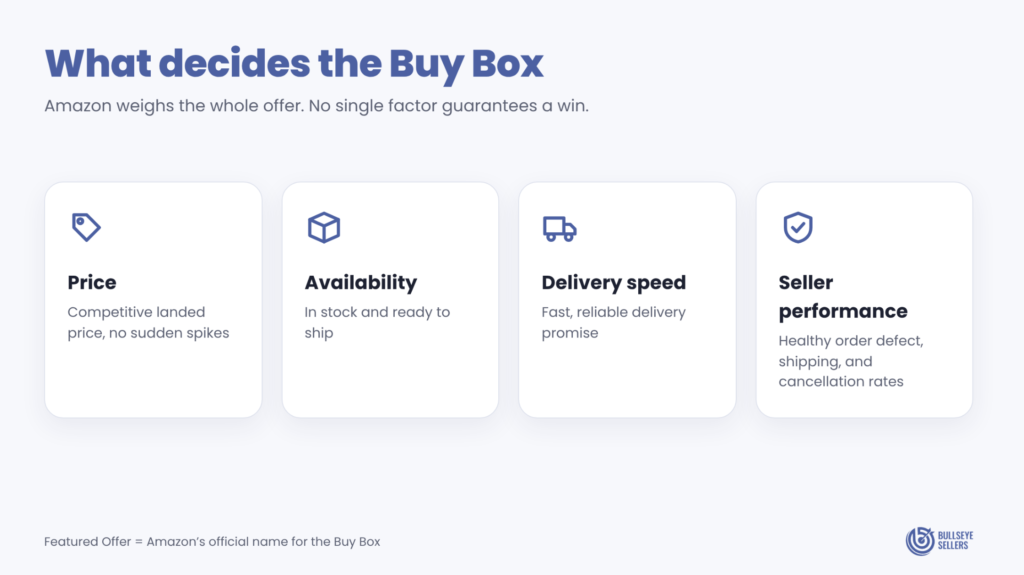

Amazon weighs several factors together when choosing the Featured Offer, and no single factor guarantees a win. The table below summarizes what Amazon evaluates and what brand owners can control.
| Factor | What Amazon evaluates | What brand owners should do |
| Price | Landed price (item plus shipping) compared with other offers | Price competitively, avoid sudden price spikes, and keep off-Amazon prices aligned |
| Availability | Whether the offer is in stock and can ship | Forecast inventory and restock before days of cover run low |
| Delivery speed | How fast and reliably the order reaches the shopper | Use FBA or meet Seller Fulfilled Prime speed standards, which Amazon tightened in July 2026 |
| Seller performance | Order defect rate, late shipments, cancellations, and valid tracking | Review Account Health daily and resolve issues quickly |
| Shopper location | The delivery promise to each shopper’s address | Expect different Featured Offer winners in different regions |
How Bullseye Sellers helps brands win and keep the Buy Box
Bullseye Sellers helps private label brands protect the Amazon Buy Box through full-service account management, 24/7 monitoring with HyperPilot™, and profit-focused Amazon PPC. Buy Box losses rarely have a single cause, so our team watches pricing, inventory, account health, and listing activity together instead of one report at a time.
Bullseye Sellers’ Amazon account management covers the day-to-day work that keeps an offer in contention:
- Inventory forecasting and FBA oversight to prevent stockouts and stranded inventory
- Daily account health monitoring for policy warnings, listing suppressions, and performance notifications
- Brand Registry management and hijacker monitoring, with violations reported through Amazon’s tools
- Pricing, coupon, and promotion strategy that protects margin without triggering price spikes
- Case management with Amazon Seller Support when a listing or offer needs escalation
HyperPilot™: 24/7 Buy Box monitoring
HyperPilot™ is Bullseye Sellers’ AI plus human Amazon operating system. It monitors each account around the clock, analyzing more than 10,000 data points a day across ads, listings, P&L, inventory, and competitors. When something threatens the Featured Offer, HyperPilot™ flags it for a strategist right away.
For Buy Box protection, HyperPilot™ tracks the signals that matter most:
- Real-time alerts on Buy Box loss, listing suppression, and listing deletions
- Buy Box status and competitor pricing, plus competitor Best Sellers Rank
- Inventory days of cover and restock alerts before a stockout hits
- Stockout-guard bid throttling, so PPC spend doesn’t outrun available inventory
Every change HyperPilot™ proposes is reviewed and approved by a Bullseye Sellers strategist before it goes live. The AI handles the constant watching, and a human makes every call.
Losing the Buy Box and not sure why? Book a strategy call with Bullseye Sellers and our team will walk through your Featured Offer performance.
Why brands trust Bullseye Sellers with their Amazon accounts
At Bullseye Sellers, our team manages 85+ private label brands and more than $60 million in monthly Amazon ad spend across Sponsored Products, Sponsored Brands, and DSP. Brands range from 8-figure 1P accounts to new launches, and 80% of Bullseye Sellers’ new clients arrive as referrals from existing clients.
One private label men’s skincare brand came to Bullseye Sellers generating under $10,000 a month. Through listing optimization, PPC management, and retention strategy, our team grew it to more than $2.4 million in annual Amazon revenue and nearly $900,000 in annual net profit.
Account health work matters just as much. A premium home appliances brand came to Bullseye Sellers restricted from selling in several high-revenue states. Our team secured approval to sell in all 50 states through compliance remediation, and the brand doubled annual revenue within 18 months.
Does the lowest price always win the Buy Box?
No, the lowest price does not always win the Amazon Buy Box. Amazon compares the full offer, including landed price, delivery speed, availability, and seller performance. A slightly higher-priced offer that arrives faster from a reliable seller can win over a cheaper offer with a slower delivery promise.
Price still matters, and not only on Amazon. The Federal Trade Commission’s antitrust lawsuit, filed with 17 state attorneys general on September 26, 2023, alleges that Amazon uses anti-discounting measures to punish sellers that offer lower prices on other sites. For brands selling on Shopify or TikTok Shop too, coordinate discounts across channels before launching them.
How private label brands protect the Buy Box from hijackers
Private label brands protect the Buy Box by controlling who sells their product and keeping their own offer strong. With the eligibility gate removed, reseller and hijacker offers that previously could not qualify now enter the ranking pool. That makes listing monitoring more important than it was a year ago.
These steps help brand owners keep control of their listings:
- Enroll in Amazon Brand Registry and use its tools to report counterfeit and policy-violating sellers
- Monitor every listing for new sellers and sudden price undercuts
- Stay in stock, since a stockout hands the Buy Box to any other seller on the listing (see our FBA inventory management guide)
- Audit distribution channels that may be supplying unauthorized resellers
- Keep pricing consistent across Amazon, your DTC site, and other marketplaces
At Bullseye Sellers, our team monitors client listings for hijackers, reports violations through Brand Registry, and runs defensive ad strategies so competitors can’t poach shoppers on your own product pages.
Additionally, our AI + human review Amazon tool, HyperPilot™, monitors your account 24/7, analyzing 10,000+ daily data points across ads, listings, P&L, inventory, and competitors, then gives a human strategist the recommendations, reasoning, and trade-offs needed to make smarter decisions.
Why losing the Buy Box stops your Sponsored Products ads
Losing the Buy Box can stop your Sponsored Products ads from serving at all. According to Amazon Ads, a product must be eligible for the Featured Offer to advertise, and if it isn’t presenting the Featured Offer or is out of stock, the ad will not display.
That turns a Buy Box loss into a ranking problem too. Paused ads mean fewer sales, and fewer sales can weaken organic rank on the keywords you paid to build. Bullseye Sellers’ Amazon PPC team ties ad spend to Featured Offer status and inventory, so budget goes to ASINs that can actually convert.
What is Buy Box suppression?
Buy Box suppression is when Amazon chooses not to feature any offer on a listing. Shoppers see a “See All Buying Options” button instead of Add to Cart, which adds a step before purchase. A brand owner can be the only seller on an ASIN and still have the Featured Offer suppressed.
Suppression is commonly tied to pricing Amazon views as uncompetitive. Check Pricing Health in Seller Central, compare your price with your recent Amazon and off-Amazon prices, and correct sudden increases quickly.
Why did I lose the Buy Box? A 6-point diagnostic
Work through this diagnostic in order whenever your Featured Offer percentage drops:
- Check stock. Confirm the ASIN is in stock and inbound FBA shipments are on schedule.
- Check for new sellers. Review the offer listing for new or undercutting sellers.
- Check your price. Compare your landed price against other offers and your own recent price history.
- Check off-Amazon pricing. Look for lower prices on your DTC site, TikTok Shop, or other marketplaces.
- Check Account Health. Review order defect, late shipment, cancellation, and valid tracking rates.
- Check your delivery promise. Confirm FBA inventory placement or Seller Fulfilled Prime speeds still meet Amazon’s standards.
For brands managed by Bullseye Sellers, HyperPilot™ runs these checks continuously, so a strategist sees the problem before it shows up as a slow sales week.
Frequently asked questions
Is the Featured Offer the same as the Buy Box? Yes. The Featured Offer is Amazon’s official name for what sellers call the Buy Box: the offer shown with the Add to Cart and Buy Now buttons on a product detail page. Seller Central reports still use both terms, so you’ll see “Featured Offer (Buy Box) Percentage” in Business Reports.
Does FBA still beat FBM for the Buy Box? Fulfillment method matters mainly through delivery speed and reliability. FBA often helps because it gives shoppers fast Prime delivery, but a merchant-fulfilled offer that meets the same delivery promise can compete. Amazon’s July 2026 announcement did not change selection factors, so test your own Featured Offer percentage before shifting inventory between methods.
How do I check my Buy Box percentage? In Seller Central, go to Reports, then Business Reports, then Detail Page Sales and Traffic by Child Item, and view the Featured Offer (Buy Box) Percentage column. It shows the share of page views where your offer was featured. Track it weekly by ASIN so drops are easy to spot.
Can I lose the Buy Box if I’m the only seller on my listing? Yes. A sole seller can lose the Buy Box through a stockout or through suppression, when Amazon decides not to feature any offer. Suppression is commonly tied to pricing that looks uncompetitive. Keep inventory steady, avoid sudden price increases, and check Pricing Health in Seller Central.
Do I still need to meet Buy Box eligibility requirements in 2026? Amazon is removing the separate seller eligibility gate in a rollout that completes by the end of 2026. Seller performance still factors into Featured Offer selection, and Amazon Ads still requires a product to be Featured Offer eligible to run Sponsored Products. Account health remains essential.
The Amazon Buy Box rewards brands that stay in stock, price consistently, deliver fast, and watch their listings every day. Ready to stop losing sales to stockouts and hijackers? Talk to Bullseye Sellers about Amazon account management and HyperPilot™, and see exactly where your Featured Offer is slipping.