To reduce Amazon TACoS without losing sales rank, use PPC to push your best keywords up in organic rank, track that rank weekly, then lower bids gradually on keywords that rank on page one and reinvest the savings. Add negative keywords, separate campaigns by match type and intent, and avoid cutting spend all at once.
Key takeaways
- TACoS = total ad spend divided by total revenue, times 100.
- Most profitable Amazon brands run 8% to 15% TACoS.
- Cut bids in 10% to 15% steps, never 50% overnight.
- Organic rank growth is what makes lower TACoS sustainable.
High TACoS is quietly destroying your margins — and most sellers make it worse by trying to fix it the wrong way.
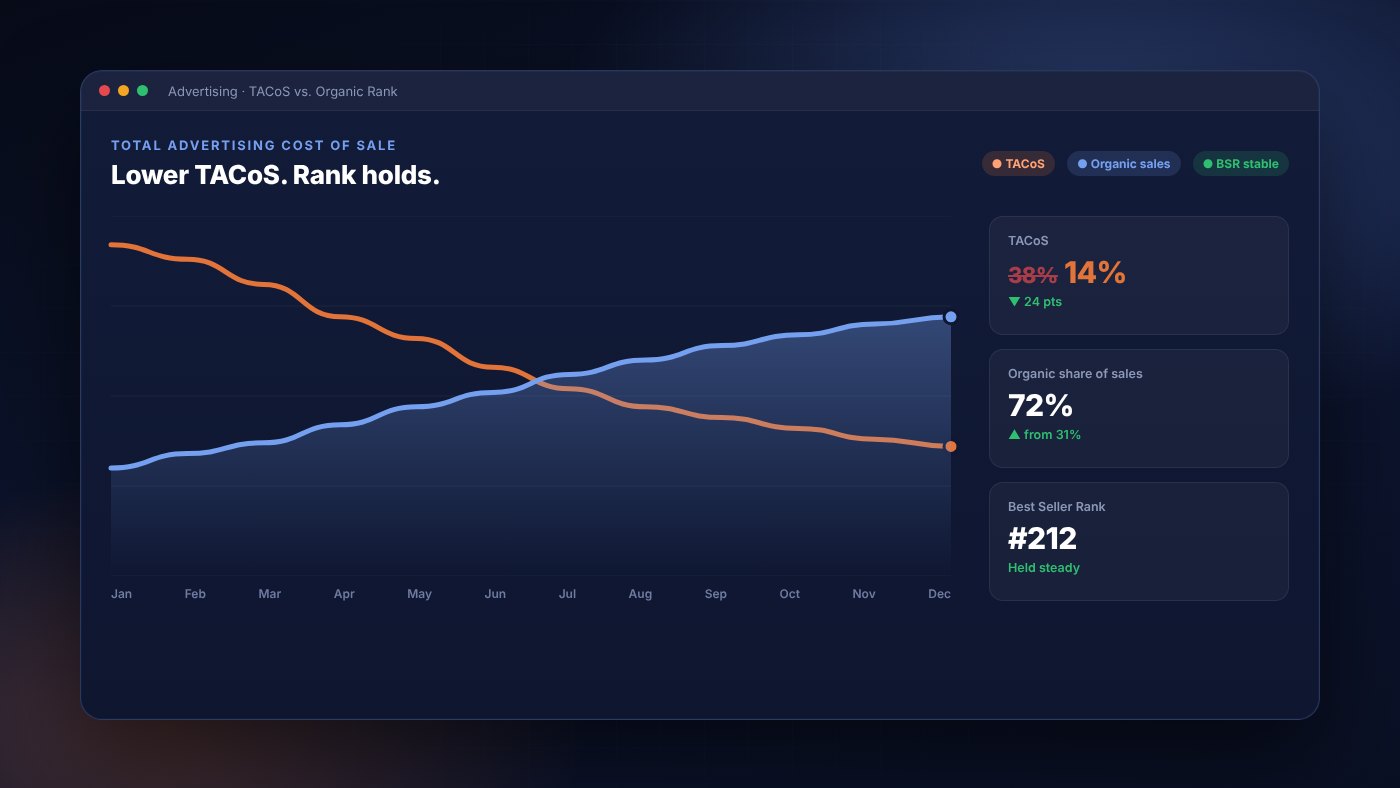
You see a 38% TACoS, panic, and start slashing ad spend. Your ACoS drops. You feel good. Then three weeks later your organic rank collapses, your BSR tanks, and suddenly you need more ad spend just to hold the position you had before.
Here’s the truth: reducing TACoS is not about spending less. It’s about spending smarter — and building organic rank strong enough to carry more of the load.
What Is TACoS, and Why Is It a Better KPI Than ACoS?
ACoS measures your ad spend against revenue from ads only. TACoS measures your ad spend against your total revenue — organic + paid. That’s the number that tells you how dependent your business is on advertising.
TACoS = Total Ad Spend ÷ Total Revenue × 100
Most profitable Amazon brands run between 8–15% TACoS. Above 25% is a red flag. Above 35%, you’re in a death spiral.
What Are the 3 Biggest TACoS Mistakes Amazon Sellers Make?
Mistake 1: Cutting Ad Spend Too Fast
When you slash spend suddenly, your impression share drops, conversions slow, and Amazon interprets that as lost relevance. Your organic rank follows. TACoS reduction is a gradual process — 10–15% bid adjustments, not 50% overnight cuts.
Mistake 2: Ignoring Organic Rank
The real path to lower TACoS is a higher organic rank, not lower ad spend. When you rank organically for your best keywords, every organic sale brings your TACoS down without touching your campaigns. Organic rank growth is the long game that makes ad spend sustainable.
Mistake 3: Wrong Campaign Structure
Broad match keywords mixed with exact match, no separation between branded and non-branded, auto campaigns bleeding into irrelevant terms. Bad architecture inflates spend and makes it impossible to diagnose where your TACoS is coming from.
What Is the Right Way to Reduce TACoS?
1. Use PPC to build organic rank. Run aggressive exact match campaigns on your highest-converting keywords. The goal is sales velocity so Amazon moves you up organically.
2. Track organic rank weekly. As your rank climbs, you generate sales with zero ad spend. TACoS falls.
3. Gradually reduce bids on organically-ranked keywords. Once you’re on page one organically, stop overpaying for that traffic on PPC. Pull bids down incrementally.
4. Reinvest savings into underdeveloped keywords. Take the efficiency gains and deploy them into keywords where you haven’t built organic strength yet.
Which TACoS Tactics Actually Work?
Negative Keyword Mining
Pull search term reports weekly. Any term converting at an ACoS above your threshold or not converting after 20+ clicks gets negated. This alone can improve efficiency 15–25% without touching winning keywords.
Bid Laddering
Use a tiered approach: top-performing exact match at or slightly above your ACoS threshold, mid-funnel phrase match conservatively, auto campaigns with tight default bids. Adjust every 7–14 days based on data.
Keyword Segmentation
Separate campaigns by match type and intent: branded campaigns, core exact match campaigns, competitor conquest campaigns, and auto/discovery campaigns. This shows you exactly where spend is going.
Dayparting
Use Amazon’s ad scheduling to pull back during low-conversion windows. You’re concentrating budget on hours where shoppers actually convert — improving efficiency without reducing daily spend caps.
Case Study: 45% to 12% TACoS in Six Months
A home goods brand came to us at $180K/month with 45% TACoS. When we audited the account: auto campaigns with zero negatives, exact and broad match mixed in the same ad groups, no organic rank tracking, and branded spend mixed with non-branded.
Month 1: Full restructure. Negatives added. TACoS: 41%. Month 2–3: Bid laddering on top 25 keywords. Core keywords moved from page 2 to top-10 page one. TACoS: 32%. Month 4–5: Bids reduced on organically ranked terms. Dayparting implemented. TACoS: 22%. Month 6: Core keywords ranking positions 3–7 organically. TACoS: 12%.
Revenue held at $185K/month. They were spending $15K less on ads. Real margin recaptured.
Results based on a representative client engagement. Individual results vary.
Results and official sources
- Bullseye Sellers has served 165+ brands across TikTok Shop, Amazon and Shopify.
- One Amazon client went from 45% to 12% TACoS in six months, with revenue 34% higher by month six (case study).
- Dr. Price's Vitamins had almost 10K units of unfulfillable Amazon inventory restored, and the listing live again, within 24 hours.
- Official references: Amazon Ads: Sponsored Products, Amazon: advertising for sellers, Amazon: selling fees and pricing.
Quick answers
| Question | Short answer |
| What is a good TACoS for Amazon sellers? | Most profitable Amazon brands run between 8% and 15% TACoS. Above 25% is a red flag, and above 35% usually means ads are carrying the business. |
| Why did my sales rank drop when I cut ad spend? | Sharp cuts reduce impressions and sales velocity, and Amazon’s algorithm reads that as lower relevance, so organic rank slips. |
| How often should I add negative keywords? | Review search term reports weekly and negate terms that do not convert after about 20 clicks or that run above your target ACoS. |
| Does dayparting lower TACoS? | It can. Scheduling ads to spend more during high-converting hours improves efficiency without lowering your daily budget. |
| Can Bullseye Sellers lower my TACoS? | We have done it for many brands, including one that went from 45% to 12% TACoS in six months. |
Frequently asked questions
What is a good TACoS for Amazon sellers?
Most profitable Amazon brands run between 8% and 15% TACoS. Above 25% is a red flag, and above 35% usually means ads are carrying the business.
Why did my sales rank drop when I cut ad spend?
Sharp cuts reduce impressions and sales velocity, and Amazon’s algorithm reads that as lower relevance, so organic rank slips. Reduce bids gradually instead.
How often should I add negative keywords?
Review search term reports weekly and negate terms that do not convert after about 20 clicks or that run above your target ACoS.
Does dayparting lower TACoS?
It can. Scheduling ads to spend more during high-converting hours improves efficiency without lowering your daily budget.
Can Bullseye Sellers lower my TACoS?
We have done it for many brands, including one that went from 45% to 12% TACoS in six months. Read the TACoS case study or see our Amazon PPC management.
Related guides
- Case Study: 45% to 12% TACoS
- Amazon Listing Optimization Checklist
- Amazon PPC Management
- What Does an Amazon Account Manager Do?
- HyperPilot AI Amazon Management
- Amazon FBA Inventory Management
Ready to Lower Your TACoS?
Bullseye Sellers has served 165+ brands on Amazon and TikTok Shop and has driven over $40M in revenue. We don’t set and forget. We manage your account like it’s our own money on the line.
Talk to the Bullseye Sellers team →