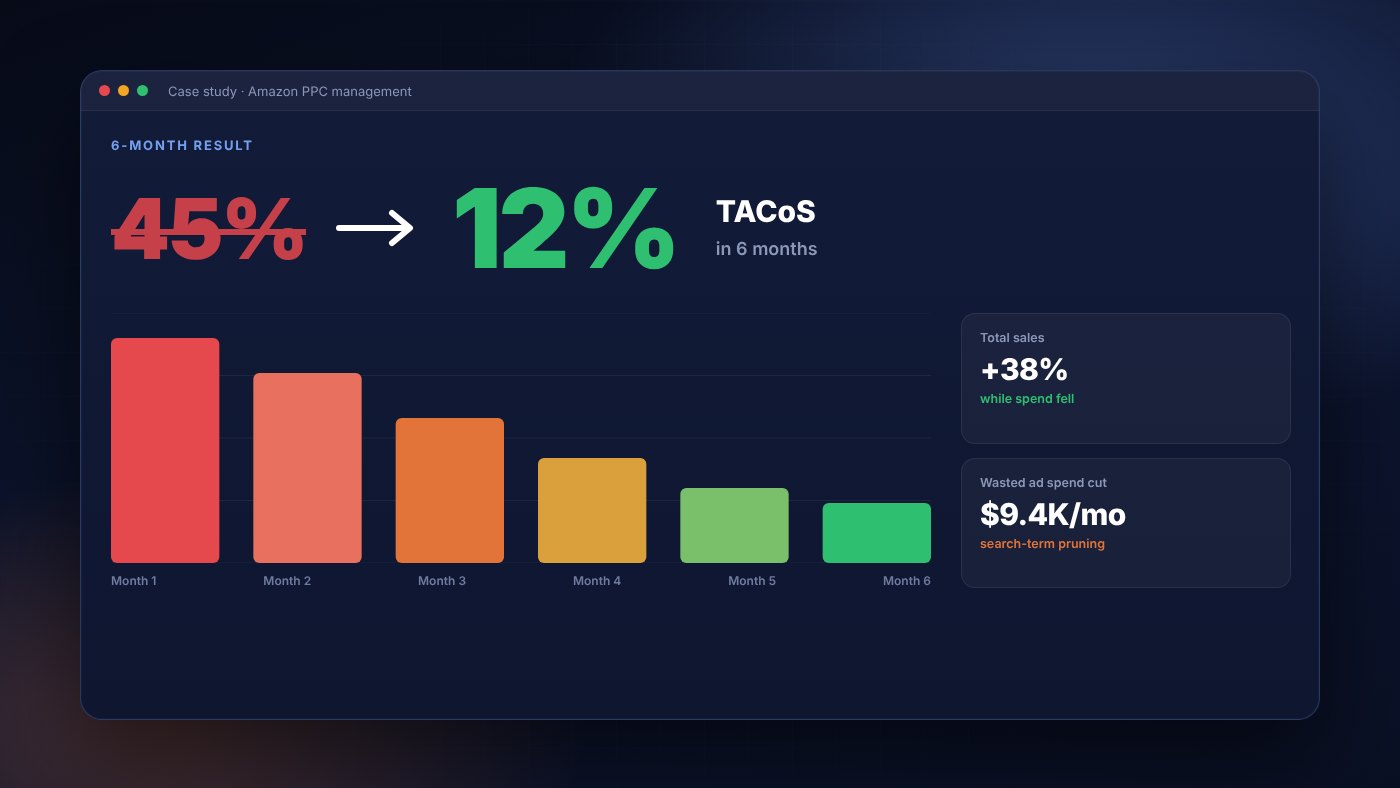
Bullseye Sellers took a brand from 45% to 12% TACoS in six months by restructuring its Amazon PPC campaigns, adding negative keywords, using exact-match campaigns to build organic rank, then lowering bids on keywords that ranked organically. By month six, revenue was 34% higher than when the work started.
Key takeaways
- The fix started with campaign structure, not cutting spend.
- PPC was used to build organic rank on the highest-converting keywords.
- Bids came down only after keywords ranked on page one organically.
- Revenue grew 34% while ad spend fell as a share of sales, so the savings went straight to margin.
A 45% TACoS doesn’t just hurt — it quietly bleeds your business dry. At that number, nearly half of every dollar in revenue is being consumed by ad spend. The brand is “growing” on paper, but the owner is working harder for less money every month.
That’s the exact situation a client brought to Bullseye Sellers six months ago. By the time we were done, their TACoS was at 12% — with revenue up, organic rank up, and a business that actually made money. Here’s the full story.
What Was Wrong With the Account at 45% TACoS?
They were doing $200K+/month on Amazon. Underneath: 45% TACoS. Ad spend was the engine keeping everything afloat — and it was burning jet fuel. Their previous agency had worked on it for a year. The spend kept increasing. The TACoS never moved. Organic rank on their core keywords had actually declined.
Core problems when they came to us: no distinction between branded and non-branded campaigns, auto campaigns running unchecked with no negative keyword strategy, broad match keywords eating budget without conversion data, no campaign isolation, and zero organic rank recovery plan.
What Did the PPC Audit Find?
Within 48 hours the picture was clear. Over 1,200 active keywords with fewer than 60 negatives in the entire account. Half the budget going to broad match terms with zero conversions over 90 days. Winning search terms from auto campaigns never promoted to exact match. Multiple campaigns bidding on the same exact terms, inflating costs. High-margin and low-margin products in the same campaigns.
What Was the 90-Day Plan?
Phase 1 (Days 1–30): Structure
Paused all broad match campaigns with zero conversions in 60 days. Built a 400-term negative keyword library. Separated branded keywords into isolated campaigns. Created campaigns per ASIN group segmented by margin tier. Promoted top-converting search terms from auto to exact match manual.
Phase 2 (Days 31–60): Organic Rank Recovery
Ranking organically on core keywords is the single most important thing you can do to reduce TACoS long-term. We ran targeted ranking campaigns with controlled velocity on the brand’s top five highest-intent keywords. Within 45 days, the brand moved from page 3 to page 1 on three of those five keywords.
Phase 3 (Days 61–90): Scale Profitably
With structure in place and organic rank climbing, we identified campaigns producing the strongest ACoS and systematically increased bids and budgets on those. The conversion data told us where to push.
The Month-by-Month TACoS Journey
Start: 45% → Month 1: 38% → Month 2: 29% → Month 3: 21% → Month 4: 15% → Month 5: 12% → Month 6: 12% (sustained)
The steepest drops came in months 2 and 3 — structural cleanup hitting at the same time organic rank recovered.
Results based on a representative client engagement. Individual results vary.
What Actually Moved TACoS Down?
- Negative keyword harvesting at scale — added negatives every week from actual search term data
- Exact match campaign isolation — top 20–30 converting terms in their own protected campaigns
- Auto-to-manual promotion workflow — every two weeks, winners moved to exact match, non-converters negated
- Organic rank push on anchor keywords — getting page 1 organically on core terms shifted TACoS 5–8 points
- Portfolio-level bid management — set target ACoS thresholds by margin and only scaled campaigns hitting them
Revenue Growth Alongside TACoS Reduction
Revenue went up while TACoS went down. At month 6, this brand was doing 34% more revenue than when they started — while spending proportionally far less on ads. The math: ad spend dropped from 45 cents on every dollar to 12 cents. That’s the difference between a business that barely survives and one that generates real profit.
Results and official sources
- Bullseye Sellers has served 165+ brands across TikTok Shop, Amazon and Shopify.
- Dr. Price's Vitamins had almost 10K units of unfulfillable Amazon inventory restored, and the listing live again, within 24 hours.
- Official references: Amazon Ads: Sponsored Products, Amazon: advertising for sellers, Amazon: selling fees and pricing.
Quick answers
| Question | Short answer |
| What is a good TACoS on Amazon? | Most profitable Amazon brands run between 8% and 15% TACoS. Above 25% is a warning sign that the business depends too heavily on advertising. |
| How long does it take to lower TACoS? | In this case study it took six months to go from 45% to 12%, with the biggest drops coming in months two to five as organic rank improved. |
| Why not just cut ad spend to lower TACoS? | Cutting spend fast usually costs organic rank and sales, which pushes TACoS back up. |
| What is the difference between ACoS and TACoS? | ACoS compares ad spend to ad-attributed sales. TACoS compares ad spend to total sales, including organic, so it shows how dependent the whole business is on ads. |
| Can Bullseye Sellers audit my Amazon PPC account? | Yes. We review campaign structure, wasted spend and keyword rank as part of a free strategy call. |
Frequently asked questions
What is a good TACoS on Amazon?
Most profitable Amazon brands run between 8% and 15% TACoS. Above 25% is a warning sign that the business depends too heavily on advertising.
How long does it take to lower TACoS?
In this case study it took six months to go from 45% to 12%, with the biggest drops coming in months two to five as organic rank improved.
Why not just cut ad spend to lower TACoS?
Cutting spend fast usually costs organic rank and sales, which pushes TACoS back up. Our guide on how to reduce Amazon TACoS explains the safer approach.
What is the difference between ACoS and TACoS?
ACoS compares ad spend to ad-attributed sales. TACoS compares ad spend to total sales, including organic, so it shows how dependent the whole business is on ads.
Can Bullseye Sellers audit my Amazon PPC account?
Yes. We review campaign structure, wasted spend and keyword rank as part of a free strategy call. Learn more about our Amazon PPC management.
Related guides
- How to Reduce Amazon TACoS
- Amazon PPC Management
- Amazon Listing Optimization Checklist
- HyperPilot AI Amazon Management
- How to Launch a Product on Amazon
- Amazon Account Management Cost
- More Case Studies
Ready to See What’s Happening in Your Account?
Bullseye Sellers has served 165+ brands on Amazon and TikTok Shop , whose combined revenue tops $500M a year. We offer a free account audit — no sales pitch, just a real look at what we find.
Get your free Amazon PPC audit →