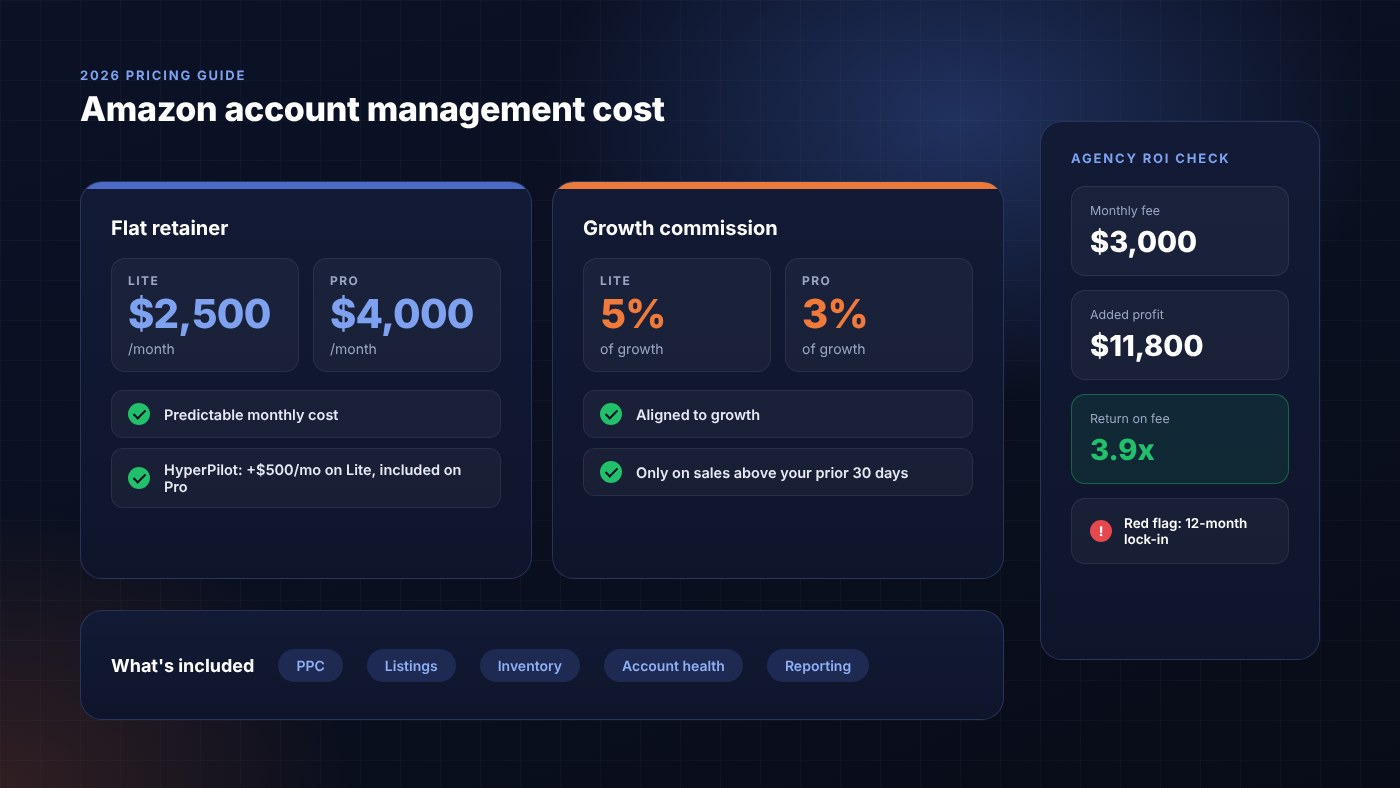
Amazon account management is priced in one of three ways: a flat monthly retainer, a percentage of sales or ad spend, or a hybrid of a retainer plus a performance fee. What you pay depends on catalog size, ad spend, scope and account condition, so compare what each quote actually manages, then judge it on the return, not the fee. At Bullseye Sellers, Amazon management costs $2,500 a month plus 5% of growth (Lite) or $4,000 a month plus 3% of growth (Pro), where growth is Amazon gross sales above your starting baseline.
Key takeaways
- Most agencies use a flat retainer, a percentage of sales or ad spend, or a hybrid of both.
- Catalog size, ad spend, scope, account condition and marketplaces drive the price.
- Fees tied to ad spend reward spending more, not spending well.
- A 3 to 6-month minimum is common (ours is month to month); a year or more with no performance exit is a red flag.
- Judge an agency on TACoS, organic rank and total revenue, not ACoS alone.
You’ve probably already Googled this and gotten a bunch of vague non-answers.
“It depends.” “Contact us for a custom quote.” “Pricing varies by scope.”
That’s not helpful when you’re running a brand doing $100K–$500K a month on Amazon and trying to figure out whether hiring an agency is actually worth it.
Why Is Amazon Agency Pricing So Hard to Pin Down?
The Amazon agency space is the Wild West. There’s no industry standard, no licensing body, and no minimum bar to hang a shingle and call yourself an “Amazon expert.”
That means two agencies can quote wildly different prices for what sounds like the same service. One “full management” package might include PPC, listings, inventory planning and account health. Another might be a PPC freelancer with a nicer website. Before you compare prices, you have to compare what is actually being managed.
What Are the 3 Amazon Account Management Pricing Models?
Almost every Amazon agency prices with one of three models, or a mix of them.
1. Flat monthly retainer
You pay the same fee every month for a defined scope of work. It is predictable and easy to budget, and it does not punish you for growing. The downside is that the agency gets paid the same whether your sales go up or not, so the scope and reporting need to be clear.
2. Percentage of sales or ad spend
The agency takes a percentage of revenue or of ad spend. It sounds aligned, but watch the incentives. A fee tied to ad spend rewards spending more, not spending well. A fee tied to total revenue pays the agency for sales your brand would have made anyway.
3. Hybrid: retainer plus performance
A base retainer covers the day-to-day work, and a performance component rewards growth. Done well, this is the most aligned model, because the agency has a floor to staff your account properly and a reason to push for results. Done badly, it is a high retainer with a performance fee bolted on.
Amazon agency pricing models compared
| Pricing model | How you pay | Upside | Watch out for |
| Flat monthly retainer | The same fee every month for a defined scope | Predictable, easy to budget, doesn’t punish growth | Agency is paid the same whether sales rise or not |
| Percentage of sales or ad spend | A share of revenue or of ad spend | Fee moves with the size of the account | Ad-spend fees reward spending more; revenue fees pay for sales you’d make anyway |
| Hybrid (retainer plus performance) | A base retainer plus a fee tied to growth | Most aligned: a floor to staff the account and a reason to push for results | A high retainer with a performance fee bolted on |
What Drives the Price of Amazon Account Management?
- Catalog size and complexity. Ten ASINs in one category is a very different workload from hundreds of variations across several categories.
- Ad spend and campaign volume. More spend means more campaigns, more keywords and more search term data to manage every week.
- Scope. PPC only is cheaper than full management covering listings, A+ Content, inventory, account health, and promotions.
- Account condition. A clean, growing account costs less to run than one with suspended listings, stranded inventory, or years of messy campaign structure.
- Marketplaces and channels. Adding Canada, Europe, Walmart or TikTok Shop adds work, even when the products are the same.
What Red Flags Should You Watch for in Agency Quotes?
- Long lock-in with no exit. Amazon is a long-term game, and a minimum term of a few months is normal. A year or more with no performance out is not.
- Vague deliverables. If the proposal can’t tell you what happens each week, you will not be able to tell whether it is happening.
- Reporting on ACoS alone. ACoS can look great while total sales shrink. Ask for TACoS, organic rank and total revenue as well.
- A price that seems too good. Very cheap management usually means one person across dozens of accounts, or software doing the work with no strategist behind it.
- No access to your own data. You should always own your Seller Central, ad account and reporting.
How Do You Tell If an Amazon Agency Is Worth It?
The right question is not “what does it cost?” but “what does it return?” Before you sign, write down where the account is today: monthly revenue, TACoS, organic rank on your top keywords, and margin after ad spend. Then compare the agency’s fee against the realistic lift in each of those over six months.
An agency that cuts wasted ad spend and lifts organic sales can pay for itself quickly. In one of our Amazon PPC case studies, a brand went from 45% to 12% TACoS in six months. That kind of result is worth far more than the fee. An agency that just maintains the status quo is not worth any fee.
How Does Bullseye Sellers Price Amazon Account Management?
We use the hybrid model: a flat monthly retainer plus a small commission on growth, so our fee only grows when your results do. There are two plans.
| Plan | Monthly retainer | Growth commission |
| Lite | $2,500 / month (+$500 / month for HyperPilot) | 5% of gross sales growth over baseline |
| Pro | $4,000 / month (HyperPilot included) | 3% of gross sales growth over baseline |
The baseline is your Amazon revenue for the 30 days before we start, so the growth commission applies only to sales above that level.
Ad spend is paid by your brand directly to Amazon and is not part of our fee. We recommend a plan after a free 45-minute call and a look at your account.
Our Amazon management is month to month, with no minimum term. Plan on at least 3 to 6 months to see the full effect, because it takes that long to index new keywords, bring ACoS down, and fix catalog issues. After that, the goal is simple: show real ROI every month.
Want to see what full-service management includes? Read about our Amazon account management service and how it compares to building an in-house team.
Results and official sources
- Bullseye Sellers has served 165+ brands across TikTok Shop, Amazon and Shopify.
- One Amazon client went from 45% to 12% TACoS in six months, with revenue 34% higher by month six (case study).
- Dr. Price's Vitamins had almost 10K units of unfulfillable Amazon inventory restored, and the listing live again, within 24 hours.
- Official references: Amazon: Learn how to sell on Amazon, Amazon: selling fees and pricing, Amazon: Fulfillment by Amazon (FBA).
FAQs About Amazon Account Management Cost
Why won’t agencies publish their prices?
Because the work varies so much by catalog size, ad spend and account condition. A fair agency will still tell you its pricing model up front and give you a clear quote after a short audit.
How much does Bullseye Sellers charge for Amazon account management?
Lite is $2,500 a month plus 5% of growth, and Pro is $4,000 a month plus 3% of growth, where growth is Amazon gross sales above your starting baseline. HyperPilot is included in Pro and costs $500 a month more on Lite. Ad spend is paid to Amazon separately.
Is a percentage-of-sales fee a good deal?
It can be, but check what it is a percentage of. Fees tied to growth reward results. Fees tied to total revenue or ad spend can pay the agency for sales you would have made anyway, or for spending more.
How long should an Amazon agency contract be?
A minimum of 3 to 6 months is normal, because keyword indexing, PPC optimization and catalog fixes take time to show results. Be wary of long contracts with no way out if performance doesn’t improve.
What should be included in full Amazon account management?
At minimum: PPC management, listing and A+ Content optimization, inventory planning, account health monitoring, review and reputation management, and regular performance reporting.
How do I know if an Amazon agency is worth the fee?
Write down your monthly revenue, TACoS, organic rank on top keywords and margin after ad spend before you sign, then compare the fee with the realistic lift in each over six months. An agency that cuts wasted spend and lifts organic sales can pay for itself; one that only maintains the status quo is not worth any fee.
Related guides
- What does an Amazon account manager do?
- How to reduce Amazon TACoS without killing your sales rank
- Amazon PPC management
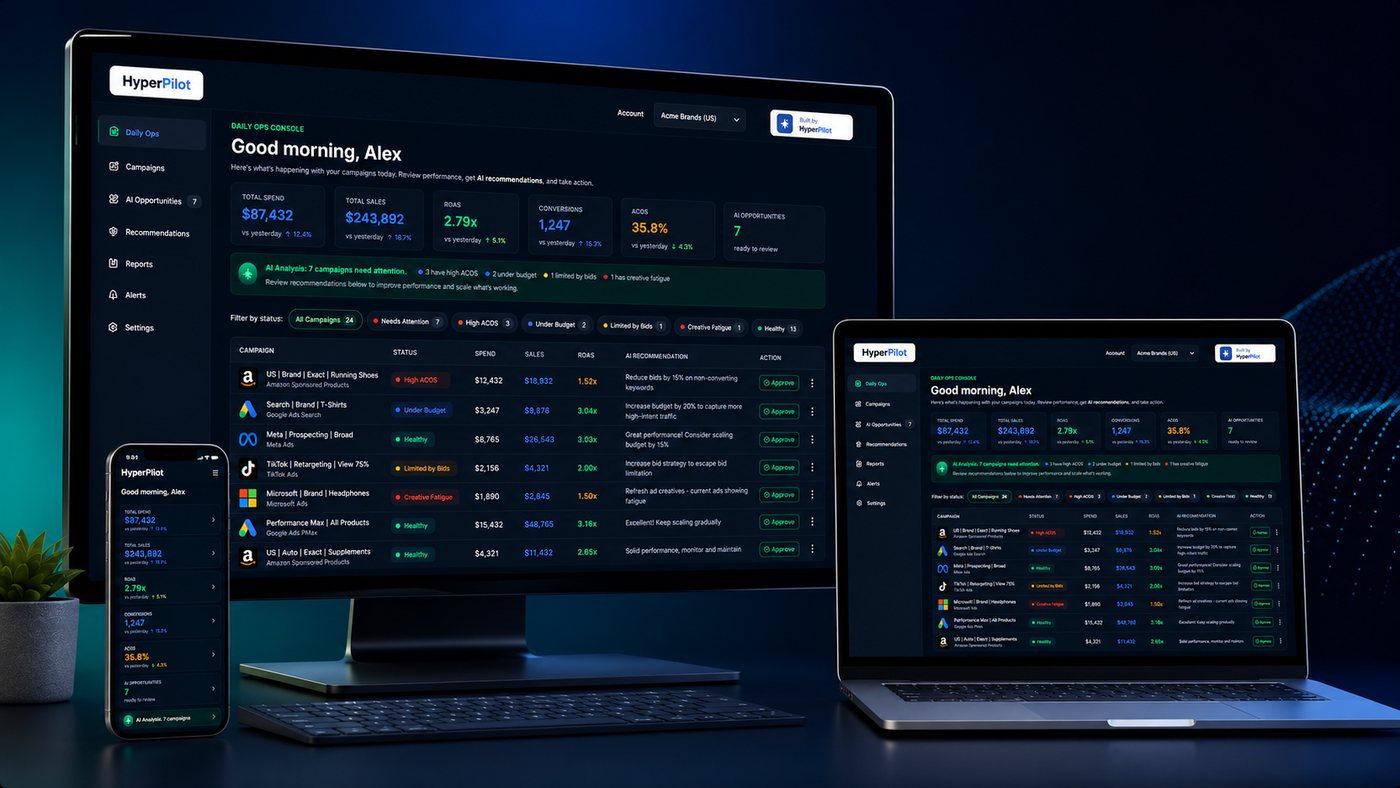
- HyperPilot AI Amazon management